3.20.2012

Warner Brothers' "Gift" to the masses?

At 6:15 yesterday morning, TCM aired the rarely-shown God's Gift to Women, a 1931 Frank Fay vehicle meant to showcase his appeal as a ladies' man. Whether this was done in seriousness or as a farce is difficult to discern, though I'd bet on the latter. Despite Warner Brothers' efforts to prime Fay as one of the biggest stars of the early '30s, Gift would signal the beginning of a downward slide. More on that in a bit...

Fade in to Paris, home to the Arc de Triomphe, the swanky Club Perroquet, and our leading man, an alleged descendant of Don Juan whose name is...Toto. [Cue the groans.] Numerous tables are passed along and set up in preparation for his arrival, anticipating accompaniment by several glamorous women. Most notable in the fracas is a bangless Louise Brooks, delightful as ever in spite of a thankless tenth billing. She enters the film with a sly turn over her shoulder, but is nearly smothered out of the frame by the arrival of Toto (Fay), Fifi (Joan Blondell), and the Sisters G. Perturbed by all of the ruckus is John Churchill (Charles Winninger), the standard curmudgeon, a disapproving father who "would rather have an alley in Rochester than all of the streets in Paris". [Whether he is referring to my home city or a different Rochester is up in the air.] In stark contrast, his daughter Diane (Laura La Plante) adores the Parisian nightlife. She spots Toto across the room, working his legendary charm all around the table, and she affirms that she's aware of his ways; she says that they're what "makes him interesting". Eventually, she catches his eye in return. He is dazzled, she is skeptical, but has a glimmer in her eye suggesting that she's ready and willing to challenge whatever doe-eyed hooey he sets forth. A game she is intent upon winning.

The music swells, and Diane, after some hesitation, takes to the dance floor, and Toto takes notice. He's "lost his heart again", according to Fifi. He sends a friend to make her acquaintance and dance with her, but when she refuses to meet him, he has one of the waiters turn off the lights briefly, with just enough time for Toto to switch places with his friend. Diane is by turns shocked, then pleased, but feigns disgust as a ruse. Toto takes the bait. He pursues her on the street the next day (presumably), and ends up bringing her to his home, albeit after getting his hand caught in her car door. He hints at marriage as she nurses him back to health, but she plays it coy. She softens to his advances during a charming tea-reading scene, but always keeps her wits about her. [Laura La Plante is a surprise saving grace in this film, her Midwestern roots shining through with every warm smile. I'm curious to see more of her work.]

Toto has a change of heart about his old ways, but his old ways won't leave him behind. He continues to be swarmed by women, if always by surprise. Diane, not entirely convinced of this turnaround, keeps herself out of the picture for the time being. Meanwhile, a preeminent doctor pays Toto a visit, but leaves him with a grim diagnosis. He is to experience no excitement of any kind; no parties, no women, zilch. One kiss could be fatal. The women learn the news, but are ignorant of the doctor's warning. One by one, they decide to sneak into his home and "nurse" him in their own special ways. Brooks, as Florine, gets the most screen time here, and with actual lines to boot. Ultimately, Fifi and Florine run into each other, and once Dagmar (Yola d'Avril) discovers them, a catfight breaks out. Seeing Toto in agony, trying to keep his heart rate down, the women remember their mission and turn to console him. An angry husband storms in and scares the women away. The doctor, in disbelief, offers to give Toto a second chance, but maintains his warning. Deciding that he wants to spend one last evening with Diane, he even goes so far as to pick out his own coffin, sure that he will indeed expire after they kiss. As luck would have it, he survives. Though it isn't so much due to luck after all...the doctor's "diagnosis" was another careful ruse on Diane's part, a test of Toto's faithfulness. The "funeral" is swiftly transformed into a wedding, and we get our happy ending.

Having read some IMDB reviews long before viewing the film, I was prepared to hate it. It wasn't terribly successful at the time of its release, even after a considerable makeover. The film was originally slated to be a musical, with songs performed by Frank Fay and the Sisters G. Fearing backlash against yet another musical film, the scenes were cut; the full film remained intact when screened in other countries, but it is currently unknown if any copies survive. While it's far from a classic, it isn't too bad. The writing is uneven but manages to get in a few zingers amidst some eye-rollers. Fay is tolerable, though I can understand why this was his final Warner Brothers picture. He was falling out of favor in Hollywood, just as his wife was on the rise: the beloved Barbara Stanwyck. Coupled with personal problems, his star would never burn brightly again. La Plante was perfectly natural and charming, a real pleasure to watch. Brooks, sadly, was largely background fodder. During the nightclub scene, she was seated in close proximity to one of the Sisters G, who sported the infamous glossy "black helmet" of Brooks' heyday. Another connection was with costar Margaret Livingston, who was Brooks' dubbed voice and body double in The Canary Murder Case after Brooks quit Paramount and defected to Europe. Her voice, rumored to not record well, sounds perfectly smooth and musical. Had Hollywood given her better opportunities, and had she not despised the cutthroat studio system (though I'm thankful that she did, honestly), she could have excelled in comedy roles. She was a fine actor opposite W.C. Fields in It's the Old Army Game, so it certainly could have been done. Despite not being given much to do, she is surely one of the few reasons anyone chooses to see this film. There are worse ways to spend an hour plus, but there are better films to see, particularly if you seek an effervescent Brook(s).

3.04.2012

The Artist at the Little Theater, 3.3.12


A quaint lunch, a charming date, and decidedly brisk weather conspired to create a delightful Saturday afternoon, which concluded with a trip to the Little. Having never gone far beyond its illustrious Art Deco facade, and with two free tickets burning a hole in my pocket, I had a fine opportunity to see The Artist and wrap my head around the post-Oscar buzz. Curiosity over this modern silent film! was strong enough to lead into some reviews, most of which led me to believe that there would be a little something missing. More on that in a bit.

We're dropped into a film premiere, opening right at the climax of A Russian Affair, the latest George Valentin vehicle. The curtains swish closed, and we have our star! Valentin flashes his suave Fairbanks grin, soaking up the audience's cheers with faithful companion Uggie in tow. It becomes obvious that Valentin lives for the adoration, and is blinded so that he nearly forgets to share the stage with his female costar. As he steps out of the theater and greets his public, he has an accidental run-in with a striking mystery girl, shortly thereafter to take on a meteoric rise to fame as Peppy Miller. She soars, he crumbles under the pressure to make talking pictures; the classic "opposite trajectories" scenario. I'm not going to go into great detail with the plot, as there are several reviews already covering that ground. Ultimately, as was the standard in most early Hollywood productions, you get the happy ending.

Despite a relatively predictable plot (and mentally bracing myself for disappointment), I rather enjoyed The Artist. Jean Dujardin, sure to receive a huge boost from this film's critical success, turned out a fine performance as Valentin. While Bérénice Bejo's Peppy Miller was pretty and fun to watch, her story wasn't terribly compelling, and her character rather limited in expression; by comparison, Clifton (James Cromwell), Valentin's chauffeur, had a far more intriguing tale despite being a minor character. Peppy's one bright spot was the scene in which she pretends to give life to Valentin's tuxedo jacket...tender and humorous. Nevertheless, I found myself yearning for the likes of Clara Bow, whose bright-eyed, vivacious personality leaps off the screen, hooks you hopelessly, and never lets you go. Then again, I don't suppose that this screenplay could have handled two strong leads.

In a bitter Hollywood stew of overblown CGI, superfluous sequels, and money-hungry 3D features, the satisfying antidote is a drop of sincerity. The Artist isn't quite there. It's a breath of fresh air from the lifeless blockbusters, but not exactly groundbreaking, especially when pitted against the very films it emulates. Having seen quite a few silent films (though I am certainly no expert...I still have a lot to learn, and gladly so), I didn't feel that swell in my heart as when viewing an epic like Metropolis, or when engrossed in a story like Pandora's Box. There was a glaze of artifice where there should have been heart and soul. If you are unfamiliar with silent film, I'd suggest that you view one of the classics first, so as to understand Norma Desmond's lament. Regardless of your comfort level with the medium, if curiosity is nipping at your heels, The Artist is a pleasant way to spend an afternoon.

9.01.2010

Playing with words.

"Imitation is the highest form of flattery."

I'm inclined to believe that Louise Brooks wouldn't necessarily agree, particularly where the work of Lee Israel is concerned. Israel has become the focus of my attention due to a recent eBay listing, featuring a letter that is purported to be of Brooks' authorship; having skimmed the text and compared the signature to other samples of Louise's handwriting, the letter sadly does not ring true to me. Whether or not it is in fact a true Brooks letter, I cannot say for certain (I would still believe that it is not); however, this issue brought Lee Israel back to my attention. Israel, a one-time biographer who, having fallen upon hard times, took to writing forged letters from the likes of Noel Coward, Lillian Hellman, and Dorothy Parker, made Brooks one of her earliest targets. She often sourced biographical material for her forgeries (including personal letters), though it seems that the Brooks letters were mostly comprised of Louise's own words, which Israel shuffled around and embellished ever so slightly. As she became more self-assured in her work, she took greater creative liberties, which ultimately caused her undoing. Israel decided to come clean with a memoir, Can You Ever Forgive Me?, which was published in 2008. I have yet to read the book myself, but I'll make it a point to do so, as I'd like to wrap my head around this woman and her work; though her intentions were dubious, there is little doubt that she is quite skilled with the English language. One last item of note: as the letters she authored were "from the realm of the dead", the deceased were thereby incapable of defending themselves or setting things right. The notion of "cheating the dead" would make me feel glum, but I take comfort as I imagine that somewhere, anywhere and everywhere, "St. Louise is listening."

8.05.2010

Stray Dog at the Dryden Theatre, 8.5.10

Another fine evening at the Dryden, spent viewing an Akira Kurosawa classic, 1949's Stray Dog. The plot is centered around a fairly green cop, Murakami (Toshiro Mifune), whose gun is stolen while riding on an overcrowded bus. Sparing a rundown of the entire plotline, the film utilized several beautiful angles and shots, many of which would feel right at home in a film made tomorrow. Kurosawa particularly favored asymmetrically-framed shots, an aesthetic consistent with traditional Japanese woodblock prints. The interchanging forced perspective close-ups and long-range shots allowed for beautiful, subtle storytelling to unfold, keeping the dialogue at a bare minimum. There was a sense that you were amidst the action, conveniently tucked behind a sheer curtain or thrust against a wall in a narrow alley as the story came to life before your eyes. Another item of note: it seems that posturing and attitude denote superiority of will and/or intelligence (at least in the Kurosawa realm). The characters with the most knowledge or experience were often leaning comfortably against a railing or table, legs folded casually beneath them. Compare Murakami's stiff stance, signaling unfamiliarity and novice status, with Sato's (Takashi Shimura, another wonderful actor) eased slouch and cool attitude.

Though there was a great deal of beauty to behold in Kurosawa's cinematography, in equal measure there was a sense of despair and dismay looming through the streets and homes of postwar Japan, culminating in a moment that will surely linger in my consciousness for the coming days and nights...(after the jump, in case you'd like to remain unspoiled by the plot)


-------------------------------------------------------------------------------------------


Murakami has at long last reunited with his Colt, though not without seeing the damage that it had inflicted upon several innocent people. Collapsed from exhaustion and blood loss, he is relieved but far too weary to celebrate. Lying next to him, in handcuffs, is the equally weary Yusa, the culprit. Worn down by a lost war and his own social inadequacies, among other factors, he is particularly sensitive. In the distance, a group of small children marches along the fields, cheerfully singing the praises of the cherry blossoms; it is at this moment, as he notices the blooms hovering above him, recalling the criminal nature that has set forth from his own hands, that his soul completely shatters. He releases a scream so primal and blood-curdling that will stun anyone and everyone in its wake. A devastating, wordless expression of humanity's unbelievable power, used alternately for better and for worse. Stark, pure, undeniably humbling.

6.11.2010

An evening at the Dryden Theatre with Ira Resnick...and Brooksie.

What a whirlwind of a Friday, particularly in the realm of all things Louise Brooks. I went out to Holy Sepulchre this morning to pay my respects (though it always takes me a while to actually find her grave...the written directions are no good when you've gotten yourself spun around so that you can't tell left from right), as I like to do from time to time. Bright sunshine and a gentle breeze made for ideal conditions, and her gravestone was flanked with lovely pink flowers, including snapdragons, a personal favorite of mine. It may seem strange to some, but I truly enjoy going to visit her. It gives me a feeling of ease and comfort beyond compare, and I could only hope that it would do the same for her. I'd like to believe that her spirit is still in Rochester, silly as that may be, but it's a thought that keeps me light.

On to the evening: there was a steady crowd in wait at the Dryden Theatre, anticipating the screening of The Canary Murder Case; the film was preceded by a discussion with Ira Resnick, author of Starstruck: Vintage Movie Posters from Classic Hollywood. Resnick, who has been collecting memorabilia since the late '60s, has invested a great deal of time and money into his collection, though a few of his pieces were acquired for as low as $35 each. As he showcased some of his personal favorites, I reflected on an interview he gave the day before on WXXI radio, and I came to realize that movie poster design is truly a lost art. Resnick voiced his disappointment (on both occasions) with MGM's promotion, citing that they placed the stars and names above all else, including the film's content. Many modern films do much the same; they seek to sell names and pretty faces, when technology and special effects are absent, and that is precisely where promotion ends. The variety of designs, techniques, and styles employed throughout Resnick's collection is astonishing, and it certainly tugs at the heartstrings. Where has the artistry gone, in the movies themselves and in their advertising? I have only owned the book for a few hours, so I have yet to fully explore and digest its contents, but I am greatly looking forward to the opportunity. (On a side note, as I was exploring the museum shop before the showing, I noticed that they are now reprinting T-shirts with Louise's iconic pearl necklace image from the Richee photo session...which I had spent years wishing for and had only come across on eBay several months before. Tempted to buy a second shirt, but only because I am certifiably nuts when it comes to such matters.)

As for the film itself, it was an enjoyable, somewhat lighthearted and campy mystery. Knowing beforehand that Louise's voice was going to be dubbed over, I had set myself up for some disappointment, and to be honest, the film took its time in building steam. It seems that the first portion of the film consisted largely of salvaged material from having been shot as a silent feature, evident in the uncomfortably long pauses between (sometimes poorly) dubbed dialogue. The editing also showcased some weaknesses in the decision to create a "part-talker", particularly with Louise's scenes. Margaret Livingston (wife of famed bandleader Paul Whiteman) not only dubbed Louise's voice, but acted as a stand-in when necessary, and this was very apparent in scenes shot from the rear or side views. The hairline was distinctly different, as was her movement...however, there was one scene where the "Canary" approached her apartment door, shot from the rear, and I could tell that it was in fact Louise. Her movement is so graceful and distinctive that it cannot be missed, and G.W. Pabst was (in my humble opinion) the only director to fully appreciate and utilize her dancing background. While I am quite familiar with Louise at this point, I wanted to get to know William Powell, whose Philo Vance largely kept this film afloat with his unique suaveness, sleek intelligence, and hushed charm; Powell is an actor I'd definitely like to see more often, and if it were possible, I'd wish to chat over a drink. The supporting cast's performances were often comical, whether intentional or not, but that made the experience, with crowd and all, that much more fun.


I know now that I want to attend screenings at the Dryden on a fairly regular basis, taking in a wide variety of films, though silents will continue to be a soft spot. Just as I was a late bloomer to music, so it is with the movies. Signed book in hand, looking up at the clear night sky, I couldn't have felt more alive and full of joy, having realized just what my new mission in life must be. Call me starstruck.

11.13.2009

In bloom.

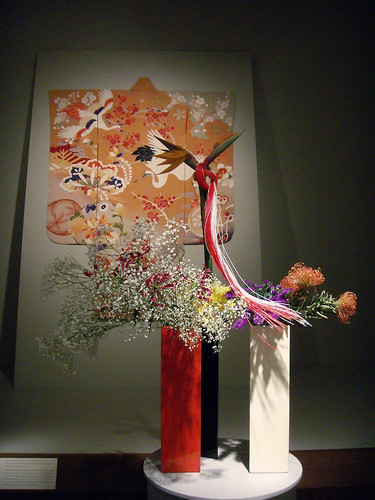
Last Saturday, a friend and I had the pleasure of visiting the Cincinnati Art Museum (a first time visit for me). We explored the exhibit on Chinese animal scroll paintings, which also featured a couple of Japanese scrolls for stylistic comparison. It's fascinating to consider the variety of forms of non-verbal communication, particularly in regards to art. The hierarchy laid out in the animal kingdom set forth the ideals and principles of Chinese law and military. In terms of the Zodiac, I fall under the tiger (having been born in 1986), so it's fitting that the tiger paintings were my favorite to view. Though, to be fair, every animal has its tale to tell. The exhibit runs through January 3rd, so there is plenty of time to experience it for yourself. More information can be found at www.cincinnatiartmuseum.org.

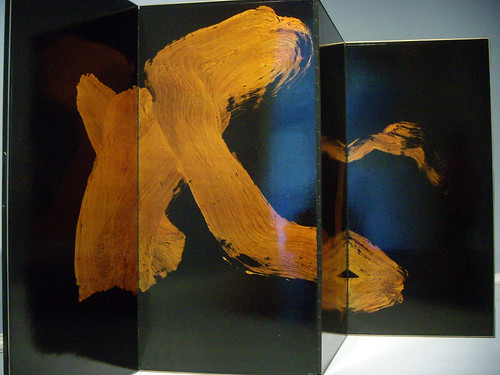
I will now share two of my favorite pieces that I saw at the museum (outside of the special exhibits...I believe they are both part of the permanent collection, if I'm not mistaken).


An elegantly displayed kimono, flanked by a floral arrangement that seeks to mimic the life and movement found within its patterns. There were several floral displays created as a part of the Art in Bloom event, including a few ikebana that I absent-mindedly neglected to photograph. I hope to become more knowledgeable of the arts of ikebana and bonsai in the coming months.


This beautiful lacquered screen reminds me of Haruki Murakami's comment about "living language", which I featured in the previous post. The swift, bold, decisive gold brushwork was executed in a way that tells a story about the very object it represents: a birch tree, standing solitary on a steep hill or mountainside. It is moments like this where I am truly awed and intrigued by the art of shodo.

I hope that you will enjoy these exhibits as much as I have.

お元気で。

11.06.2009

Is the pen mightier?

An editorial in the New York Times (featured here: http://www.nytimes.com/2009/11/08/books/review/EParker-t.html?_r=1&emc=eta1) addresses the rapid advances in modern communicative technologies and their impact on the Japanese vernacular. Minae Mizumura laments that Japan "devotes less time to teaching their own language than to teaching a foreign language." On the other side, famed novelist Haruki Murakami takes a wonderfully refreshing perspective on the issue.

"My personal view on the Japanese language (or any language) is, if it wants to change, let it change. Any language is alive just like a human being, just like you or me. And if it’s alive, it will change. Nobody can stop it."

To read more, follow the above link. Feel free to add your own comments and thoughts here.

お元気で。