Showing posts with label film. Show all posts

11.22.2021

Of rats and autograph seekers.

What a treat in celebration of Edith Meinhard's birthday this year! News is a rarity, but thanks to a fellow fan in the Louise Brooks Society Facebook group (cheers, Susanne!), we can at last fill in some biographical gaps. In 1947, Edith married a man named Evald Verner Jensen, which tracks with listings I had previously found in West Berlin phone books in the 1960s. 


The above was taken from the 1968-69 phone book, which would be the last time she was listed. Edith passed away on June 26, 1968, at the age of 59. (Thanks also to Matthaus Edinger for this information.)

Also thanks to the LBS group, I came across a 1931 interview she had done for Mein Film magazine. Her charm and talent was recognized by many, and rightfully so. Without further ado, please enjoy!

(Unfortunately I only know a few German words, so the following has been automatically translated, then edited for clarity to the best of my ability. Apologies for any awkwardness herein, some things don't work out smoothly into English. I've also included scans of my personal copy for posterity.)


    I am extremely happy to be immortalized in your beautiful anniversary edition, and I would like to take the opportunity to tell you that I "got hooked” early on. My first film appearance was at the age of ten, and I was chosen by Maxim Film, who were filming an adaptation of Felix Hollander's novel "The Dancer", to play the role of the hero as a young boy. With my beguiling violin playing I could lure the rats out of their hiding places!

    God, was I scared of those rats! Even though I had made up my mind, oh, to be so brave, it took a while before I got used to the rats, and until the rats got used to me.

    This first role brought me great success and I was delighted to be able to admire my picture in all the postcard shops! And then came the high point of my ten-year existence: I was asked for an autograph! I was blessed! That seemed to me to be the culmination of fame!

    I have since overcome this overwhelming first request for my autograph, but I am always happy when I receive nice autograph letters. And for the fun of your kind readers, I will reproduce the following letter from two dear boys that I recently received:

Well-born, beautiful, gracious diva, you, our favorite film star, Edith Meinhardt!

Two of your biggest admirers send greetings and wish you the best of luck with all your films. We've seen such wonderful films with you and we cannot fail to write to you. We ask and implore you, beautiful diva, to give us two beautiful autographs. Please, please, be so good - there are no photos here, we beg you to provide some for us, and yet we hope that you are good to us, our joy would be immense. Please, please, if you can, I, Gustav B., would like a photo where you are already grown up [?], please, please, my dear one, where you can show more of your wonderful figure. Please see what you can do.

    Isn't that nice?

    I send my warmest greetings to your charming readers and the gracious editorial team, and I wish you continued well-deserved success!


I couldn't write her for an autograph, but I'm lucky to have one just the same.


12.12.2020

Old Hollywood Kitchen: Dennis Morgan

This post has been sitting in my drafts since April. At least now it's seasonably appropriate, especially since today's star is in one of my favorite holiday films, Christmas in Connecticut. Perhaps you need a warm, comforting dessert to enjoy while you watch...


Dennis Morgan's Apple Surprise

2 pounds green apples
1/4 lb. butter
1 cup brown sugar
2/3 cup flour
1 tsp. ground cloves
1 tsp. cinnamon
Ice cream or whipped cream


Simple and satisfying like any fruit crisp, and an easy alternative to apple pie for less experienced bakers. Worth breaking out the best vanilla ice cream you can find, too. Stay safe and healthy, everyone, and happy eating!

7.11.2020

"Ring twice."

It's been a long time (nearly two and a half years!) since I last posted about Edith Meinhard, largely due to a lack of new information, but I've been spurred on by recent social media activity to share more items from my collection. I thought I'd follow up on this post with photos from Voruntersuchung, a highly recommended film if you've only seen Edith in Diary of a Lost Girl. In addition to the DVD linked in that post, there is also a Spanish-subtitled version on the Internet Archive. The captions are translations of the snipes found on the back of each photo.

"The witnesses are waiting to be questioned." Edith is seated on the far left.

"Albert Bassermann (examining magistrate) interrogates Charlotte Ander (his daughter)."

"The accused before the examining magistrate."


"The real killer is caught in the courtroom."

"Sound film recording in the streets of Berlin. Under the microphone, Gustav Frohlich and Hans Brausewetter."

Page from the Voruntersuchung program, with Edith's Mella Ziehr pictured in a happier time.

The film has fine performances all around, particularly from Albert Bassermann. This was my introduction to Bassermann, and until I attended a nitrate screening of The Red Shoes two years ago I had no idea he acted in any English-language films! He's also great in Alfred Hitchcock's Foreign Correspondent, which now tempts me to rewatch with a giant bowl of popcorn...

4.30.2020

Old Hollywood Kitchen: Zachary Scott

Well, 2020 hasn't given us much to cheer about so far. In the midst of necessary quarantine and social distancing, it can be difficult to drum up positive thoughts. Escapism is my go-to relief, and at the moment consists mostly of catching up on unwatched classic films; as I'm sticking with tried-and-true recipes (and those with minimal ingredients) to keep myself fed, I've been neglecting my stack of vintage cookbooks. It's high time I tackle my backlog of old recipe tests, starting with this comforting noodle dish:


Zachary Scott's Noodles Mecca

1 package medium noodles (I used egg noodles)
1 1/2 lbs. ground round steak
2 large onions, ground
2 kernels garlic
1/4 tsp. cayenne pepper
1/4 tsp. chili powder
1/2 lb. grated cheddar cheese
2 cans condensed tomato soup

In this first attempt I halved the ingredients for a smaller serving size, including the tomato soup; unfortunately this left the casserole a bit dry. The flavors and texture were good otherwise, though I'm wondering if green pepper wouldn't jazz this up some more. I definitely will use two cans of tomato soup the next time around.


Zachary Scott is perhaps best known for his work in Mildred Pierce, a great film all around, but I have to recommend the fun noir Flaxy Martin, which also features the wonderful Dorothy Malone. Whatever you choose to watch, I hope you and yours stay safe and healthy.

9.15.2019

Old Hollywood Kitchen: Marlene Dietrich and Karen Morley

It started simply enough: one weekend I developed a craving for banana bread, and conveniently had a couple of overripe bananas to put to good use. I realized that I had one vintage recipe to re-test and one I had never used (and a tried-and-true third recipe, my own mother's). Thus, here it is, my first side-by-side recipe comparison; a tale of two banana breads.


Marlene Dietrich's Banana Nut Bread

1 3/4 cups all-purpose flour
3/4 tsp. baking soda
1 1/4 tsp. cream of tartar
1/2 tsp. salt (I omitted)
1/3 cup shortening
2/3 cup sugar
2 eggs
1 cup mashed banana pulp (usually 2 bananas)
1/2 cup finely chopped walnuts


The first test of this recipe taught me a valuable lesson: modern ovens run hotter, and with more consistent temperature than their 1930s predecessors. As such, one full hour in a 350 degree oven proved nearly fatal for the poor loaf. The bottom half was dry and tough, the top half just barely edible. It practically has a tan line! Try again.


The second attempt fared much better. I kept a closer eye on the oven timer and pulled the loaf out after 45 minutes. Improved texture, though still a touch dry. I was running low on walnuts this time around, and I'm not sure if that had an impact on the moisture levels.

Now, how about that "new" recipe?


Karen Morley's Banana Bread

1 cup sugar
1/2 cup sour cream
2 eggs
1 tsp. baking soda (sifted with flour)
2 tsp. milk
2 cups flour
3 bananas, well mashed


Baked at 300 degrees for about 55 minutes, this loaf turned out moist, even a bit chewy, likely owing to the use of sour cream. This recipe may edge out Dietrich's as I'm not accustomed to putting walnuts in banana bread and prefer it without them. I plan to make it again sometime and may let it go a full hour in the oven to see how that affects the texture. Overall, I still prefer my mother's recipe (also without walnuts) over these two, but I'm willing to try either of these again.

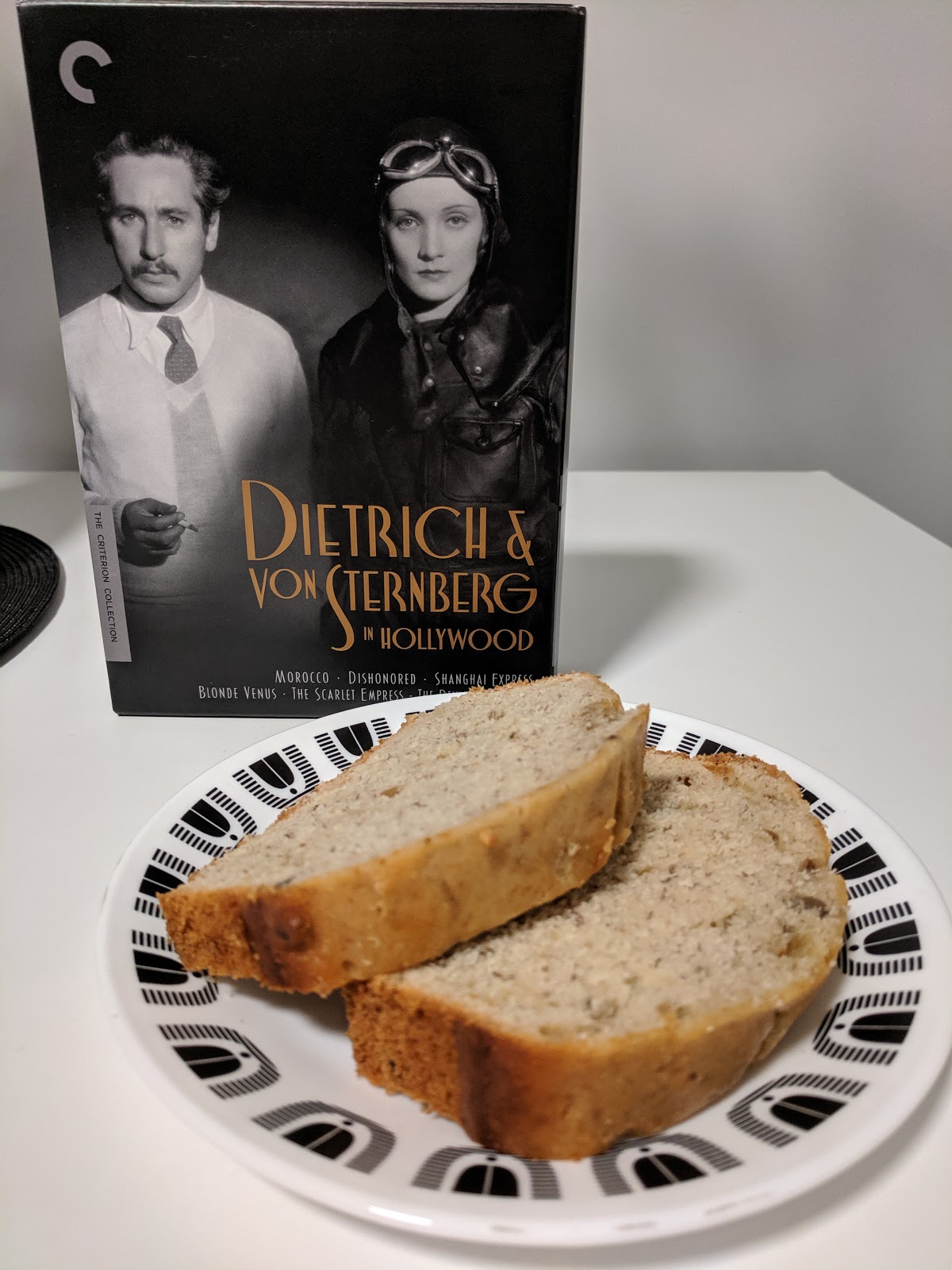
I've included my movie recommendations in the photos above. The Dietrich and von Sternberg in Hollywood box set is a wonderful Criterion release and will hit the spot if you're looking for a heady dose of (mostly pre-Code) glamour. I've chosen another pre-Code gem, 1932's Arsene Lupin, for Karen Morley, who matches wits with John Barrymore's suave gentleman thief. Happy watching, and happy baking!

6.03.2018

High Contrast: My Time at The 4th Nitrate Picture Show

A water-damaged nitrate print of F.W. Murnau's Sunrise.

I've had sufficient time (and sleep!) to absorb the proceedings of this year's Nitrate Picture Show at the George Eastman Museum's Dryden Theatre, which for me is a short drive away. The festival gathers a unique mix of industry professionals, film students and fans from places near and far, all for a program that is kept under wraps until the Friday morning of the Show. The Dryden Theatre has the distinction of being one of the few movie houses in the world with the capability to project nitrate film, a notoriously volatile medium. Nitrate film reels are also surprisingly durable and can last many years provided that they're stored in a tightly controlled environment to curb further deterioration. As a relative novice to classic film, the Nitrate Picture Show is a great opportunity for me to explore works both popular and obscure, most of which I've never heard of or seen.

My "initiation" to nitrate film was in 2017, three months before the 3rd Nitrate Picture Show. Another new-to-me film, 1937's A Star Is Born, boasted both strong lead performances and a soft, warm-toned Technicolor print. A long-term relationship came to an abrupt end that April, and I was ready to try something new. Having never been to a film festival, looking for a distraction, and realizing the NPS wasn't out of reach as I had previously thought, I secured my pass at the last minute. Unsure how to pace myself for an event like this, I attended two screenings on Saturday, with a lecture in between. Sunday was a one-screening day for me, but unforgettable: the traditional Blind Date with Nitrate that caps off each Show was a wild ride, Teuvo Tulio's Levoton veri (Restless Blood). Regina Linnanheimo took cues from Bette Davis' performance in Dark Victory and added a heaping helping of intensity; the film dragged in parts and was saddled with a loathsome love interest, but you couldn't pull away from Linnanheimo's Sylvi, slowly unfurling as her life descends into madness. I've seen dozens of movies since, but her performance sticks with me to this day.

Jump ahead to this year, and I knew what I was getting myself into. I blocked off a four-day weekend (you need at least one day to recover!), though I had to miss most of Friday's programming to attend an out-of-town memorial service. My first film of this year's festival was well worth the wait: a late screening of a rare sepia-toned print of 1938's Holiday, a charming, underrated Katherine Hepburn/Cary Grant vehicle. It's the only film I had seen prior to the NPS, and not only was it great fun as expected, the nitrate print brought lush textures to the forefront: the sunlight streaming through the windows, the glow of a solitary reading lamp, the plush velvet of a settee, the sparkle and flash of a diamond necklace. I wished it were possible to wrap myself in their warmth; I expect they'll reappear on my next viewing, if only in memory.


Saturday: an early start with insufficient sleep to recover from the previous night, the struggle was compounded by a 2 1/2+ hour Somerset Maugham drama, The Razor's Edge. I wanted to sympathize with Larry Darrell's internal conflict and his search for fulfillment. Especially through tired eyes, Edge steeped too long in its own message, aiming for profundity that wasn't quite there, and at the cost of reasonable pacing and a truly believable Tyrone Power performance. To keep interest I waited anxiously for the next scene with Herbert Marshall's Maugham (a self-insert I can get behind) or for Clifton Webb's Elliott's next cutting remark, and wondered why the great Elsa Lanchester got so little screen time (as ever, she made the most of it). Would it have been less of a slog had it been programmed for midday?

The next feature, Mlhy na blatech (Mist Over The Moors) was a glimpse into rural life; it was an easier sit than fellow Czech film Sirena (The Strike) from last year's NPS, but should have taken more advantage of its stunning natural setting to elevate it above standard drama. The titular mist danced above gently rippling water and mingled with rays of sunlight streaming through the trees in a brief, dreamy sequence. Winchester '73 was my "skip" of the day so I could stop home for a catnap and dinner before the final program, The Red Shoes. Having seen only a few short clips, I was pleasantly surprised that it lived up to the hype, beautifully orchestrated with lush Technicolor to match. Moira Shearer lures you in with her subtlety off-stage, but is startlingly intense in her dance sequences. After drying my tears (that ending!), I headed to the after-party with every intention of being social. Fatigue and anxiety got the better of me, though, so it was back home until...


Sunday: Not as late a night as Friday, which allowed for more sleep, thankfully. The first film of the day was Robert Siodmak's Cry of the City. I was somewhat familiar with Siodmak from his 1931 production, Voruntersuchung (featuring blog favorite Edith Meinhard), but a film noir on nitrate is a must-see no matter who's in the director's chair. In stark contrast to The Razor's Edge, City was the perfect first program of the day! Solid acting all around (especially Shelley Winters, cracking wise in a fabulous leopard-print coat), and the best showcase of the "nitrate effect": deep black shadows and gleaming highlights working in tandem to enhance the angular cinematography. A great addition to my slowly-growing noir vocabulary. The craving for a bowl of Mama Rome's piping hot minestrone lingering through the lunch break, it was on to the penultimate film. Vesyolye rebyata (Moscow Laughs), my first Soviet cinematic experience, was an off-the-wall musical comedy. Interspersed with slapstick reminiscent of early Marx Brothers features, the highlight of the chaos was a mob of farm animals crashing an elegant dinner party. Rounding out the 4th Nitrate Picture Show, the Blind Date with Nitrate brought us to the Aran Islands west of Ireland, with 1934's Man of Aran. A quasi-documentary, the film depicted the islands' inhabitants enduring crashing waves and turbulent storms to subsist on and around the rocky soil. I took away a deeper appreciation for the labor of the farmers and fishers, even if the shark hunting sequence was fabricated for box office gains.

All in all, my first "full" Nitrate Picture Show was an experience to treasure. I made it to 7 out of 10 film programs, one lecture, a tour of the projection booth (the Monday after the festival), several demonstrations of nitrate film reels, and I got to rub elbows with interesting people from all corners of the globe. Admittedly, as a beginner to the film festival grind, I at first felt out of place. It can be difficult to navigate a situation where you're surrounded by professionals from several film archives, as well as colleagues or students from the Eastman Museum's Selznick School of Film Preservation, and you want to learn more about them and the work that they do without feeling like too much of an outsider; anxiety in any form makes the task that much more daunting. Persistence does pay off, as I was able to connect with another attendee (via Twitter) and we conversed for hours; with any luck we'll meet up again for next year's show.


If you're new to classic film and/or film festivals and considering attending the Nitrate Picture Show, I recommend it wholeheartedly. Getting out of my comfort zone has helped to build my confidence and better handle unfamiliar situations, in addition to seeing some beautiful prints and learning more about the history of nitrate film and the efforts towards its preservation. Even if I didn't love the films that were being projected, there's always something to appreciate in the process. I'm grateful to the George Eastman Museum and the numerous museums and film archives the world over for their continued collaboration, for the opportunity to experience a rare and fleeting beauty.

4.08.2018

Old Hollywood Kitchen: Mary Carlisle

In my quest to build culinary skills via vintage recipes, I have found a new ally: What Actors Eat When They Eat, compiled by actors Rex Lease and Kenneth Harlan and published in 1939.


More substantial than Favorite Recipes of the Movie Stars, I've been overwhelmed when trying to pick out test recipes. Several hearty soups, chilis, sauces, and rice dishes up for contention. Thankfully I found relief in a simple beverage recipe from Mary Carlisle, who is still going strong at the age of 104(!).


Mary Carlisle's Cafe Froid (serves 2)

1 cup cold coffee
3 tablespoons ice cream (no flavor specified- I used French vanilla)
Ginger ale (one 7.5 oz. can was sufficient for two servings)

Mix the cold coffee and ice cream in a bowl (better if you let the ice cream soften a bit) using either a whisk or a hand mixer, which creates a frothier texture. Pour the mixture into glasses and top off with the ginger ale.


At first I was wary of the ginger ale/coffee combination; it's unusual but surprisingly refreshing. I'll give it another try in the warmer weather as a pick-me-up. 

Plenty of recipes to choose from for my next test, but until then, why not raise a Cafe Froid toast to Mary Carlisle and enjoy 1935's One Frightened Night, a fun "spooky house" film in the vein of the previously-recommended The Cat and the Canary. Mary is a highlight even among a solid supporting cast, and the film is readily available online as it is in the public domain. 

2.25.2018

Ein autogramm?

A short time ago I acquired this lovely photo postcard of Edith Meinhard:


Advertised as an autographed photo, it was likely taken between 1937 and 1940 in the midst of some of her most prominent film roles. However, prolonged inspection of the "autograph" along the left margin reveals that it is anything but. The scale of the writing, the placement and the unusual penmanship (a cursive H written as an F?) just don't add up. Compare this to her actual autograph:


I purchased the photo knowing that it wasn't inscribed with an autograph, but it's still a great, rare image, and a fine addition to a slowly growing collection.

As a bonus, the Anny Ondra/Max Schmeling vehicle Knock Out- Ein junges Mädchen, ein junger Mann is now available to stream in full on Archive.org! Edith only appears in the first 25 minutes of the film, playing catty showgirl Melitta; though one of her many small roles, she makes it memorable.

She's got the look.


2.04.2018

Old Hollywood Kitchen: Laura La Plante

One of my goals for the new year (and beyond) is to build my cooking and baking skills and be more confident in the kitchen. What better way to experiment than to bring in my love of classic film? There are many fine websites that explore celebrity recipes, but as a relatively inexperienced cook, intimidation has kept me from trying them out myself. Until now.


Perusing my stack of cookbooks, only one stood out: a well-preserved copy of Favorite Recipes of the Movie Stars, published by Tower Books in 1931. It's a slim volume, but varied in the types of recipes it offers, from light sandwiches to stews, breakfast to dessert. I figured the easiest way to take the plunge was to test a recipe with no actual cooking involved.


The charming Laura La Plante offers her Favorite Salad, an ambrosia-like creation that she recommends serving in lettuce cups along with crackers or cheese straws. The challenge with this recipe was determining the proper proportions of ingredients. How many ounces was a can of pineapple back then? A box of marshmallows? Is 1/2 pint of cream enough? Here is the recipe as I made it, with noted modifications:

Laura La Plante's Favorite Salad (updated)

1 20 oz. can crushed pineapple, drained
1 10 oz. bag mini marshmallows (I used about half of the bag)
1/2 pint whipping cream
Crisp lettuce leaves
Small crackers or cheese straws (optional)
Mayonnaise (I omitted- the heavy cream was sufficient)
Dash of paprika


Even with my changes I followed the recipe as written, and it turned out pretty well! I had hoped to find the fruit-flavored mini marshmallows to add more color, but no luck. The next time I make this recipe I might even incorporate more fruit, like maraschino cherries. As a thank-you to Ms. La Plante I'd like to recommend one of her films: the spooky, fun silent The Cat and the Canary, wonderfully restored by Kino Lorber.

(Edit: I have since made this salad with just the crushed pineapple, whipped cream and fruit-flavored marshmallows, to great success! Lighter than your standard ambrosia salad without cloying sweetness. It's like eating a pastel Art Deco cloud, if that makes any sense.)

Are you interested in making this or other film star recipes? Do you have a tried and true favorite? Feel free to share in the comments, and enjoy!


7.01.2017

The more Glenda, the merrier.

In continued celebration of the lovely Glenda Farrell's birthday (June 30), what better time to share more wonderful portraits?


Promotional portrait for The Secret Bride (the snipe refers to the working title of Concealment).

Swathed in stripes. Portrait by Elmer Fryer.

"Glenda Farrell, star of the films, is shown here in her latest gown for formal evening wear. It is a tuxedo suit of claret colored satin. Her tailored blouse is flesh marquisette with tiny pleated cuffs and a bow tie at the neckline. Her poke bonnet hat has a starched veil of the same shade as her suit."

"Glenda's Weakness is Black and White. Glenda Farrell, star of the shadow drama, can't resist costumes which feature the ever popular black and white motif, and in this one she found a really unique adaptation of the blending. Her dress is of black woolen cloth and the lapels, hat and high gauntlet gloves are of leather."

Promotional portrait for The Keyhole. A fantastic animal print combination that looks...
...quite familiar! Still from The Mystery of the Wax Museum.

1.29.2017

In the cards.

While Edith Meinhard may not have been a superstar in her heyday, she did have fans who sought out her autograph, received substantial press for even minor roles, and was popular enough to be included on collectible cigarette cards. 

Borg cigarette card, ca. 1932.

Macedonia cigarette card, early 1930s. Love the hat!

These are the only two cards currently in my collection, but there is at least a third card that has been produced (number 18 in the linked Aurelia series). For anyone who may be interested, Edith's card from the Macedonia series is available for purchase on eBay (number 42 in the pulldown menu) as of the date of this post. I'm curious to learn more about the photographer behind these images, Yva. What a fascinating (though ultimately tragic) life and career.

12.25.2016

Glad tidings.

Warmest wishes to all this holiday season! A new job (among other things) has kept me busy, but I wanted to take the time to spread some joy and cheer, this time in the form of the wonderfully hardboiled Glenda Farrell. She's become a perennial favorite and my go-to for comic relief, and she could do it in style...

Promotional portrait for Man's Castle. "The dress has a definite [bateau] neckline with a border of galyak that emphasizes the shoulders. The sleeves are modified leg-o-mutton and the belt is black suede. An unusual belt clasp has a very cute holder for a red lipstick in the center. A red pin is fastened in the black galyak trimming. Black purse, black kid shoes, black galyak hat and cream suede gloves are used with the dress."


Promotional portrait for Go Into Your Dance.


The first Glenda Farrell photo I ever purchased, featuring a dress worn in Havana Widows. I adore the beaded starburst design.


Promotional portrait for Man's Castle. "This swagger suit is fashioned of rough grey wool alternately striped in black and white and trimmed with a broad mannish collar of black Persian lamb fur. In this photograph the broad shoulders are stressed, proving once again that Hollywood creates its own fashion decrees. Miss Farrell has chosen a grey cloth hat fashioned of the same plain material as the skirt of her suit. Her other accessories for wear with this outfit are of black, resulting in an effective blend of gray, black and white."


Promotional portrait for The Big Shakedown. "Her fall street frock is of brown crepe trimmed with stitched white crepe, and the matching hat is created along the new Chinese trend, with a pointed peak. Orry-Kelly designed them."

9.11.2016

Second dance.

Edith Meinhard is best known for her Weimar-era work, most notably 1929's Tagebuch einer Verlorenen (Diary of a Lost Girl), but she also held status as a featured player with major German film studio UFA in the late 1930s. Unlike the few UFA projects she completed earlier in the decade (such as 1931's Voruntersuchung), these roles were relatively minor, but she received substantial press just the same.


               Top photo, Edith is on the top left. Bottom photo, Edith is second from right (the "3"). Photo credit.


A lovely, lucky recent find.

Another acquisition, a promotional photo for 1939's Hallo Janine!